Sunday, June 3, 2012

Carolingian Manuscript Art - Part One


Thanks to Deborah J. for presenting a fabulous class on Thursday! None of the rest of the TAG-5 had even thought of manuscript art and how it began. This is where five heads are better than one when studying art history! Following is an overview (tome-like!) of her presentation. The first part is mostly groundwork and the second is mostly images, so please stay tuned:

See the blue area? That's Charlemagne's kingdom!  Some of the city/town names shown will become significant in this post.  For example: Aachen (underlined in red), and Revenna, Italy, etc.


Frankish King Charlemagne’s palace was located in Aachen, formerly Austrasien, now in Germany.  Most of the original palace was destroyed (long story!), but the palace chapel is still intact.   Aachen’s palace chapel, built in ca. 547 AD was designed by an architect named Einhard whom you will lhear about later in this post.  The chapel’s architecture was derivative of the  Basilica of San Vitale  in Ravenna, Italy. So the groundwork of manuscript begins. (A Basilica is another word for church)
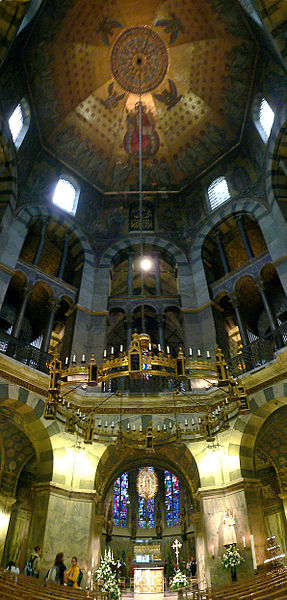


Construction of this palatine chapel, with its octagonal basilica and cupola, began c. 790–800 under the Emperor Charlemagne. Originally inspired by the churches of the Eastern part of the Holy Roman Empire, it was splendidly enlarged in the Middle Ages. N50 46 28 E6 5 4, KMH1975, Creative Commons Attribution-Share Alike 3.0 Unported 

The Palatine Chapel is another name for Charlemagne's personal palace chapel.


Profile view of charlemagne's throne in the Palatine chapel.


Exterior view: Basilica of San Vitale, Ravenna, Emilia-Romagna, Italy. Author: Tango7174. Creative Commons Attribution-Share Alike 3.0 Unported

Until the Carolingian period, churches looked fairly plain on the outside, but on the inside they were quite elaborate.  Around 875 A.D., more Christian churches were being built and they began to have a few more decorative elements on the outside.  The building’s footprint also expanded as more people were seeking the church to guide them, thus more churches/cathedrals were constructed.   What did all this mean?  It meant that more and more manuscripts needed to be hand written to meet the needs of all those churches. And since manuscripts came from the monasteries (as studied earlier), they became a manuscript production facility so-to-speak!   Each  individual ‘manuscript production facility’ began to take on certain characteristics of the individual monasteries. 

A man named Alcuin (or Albinus) was the leading scholar of the day and started in York, England as a headmaster in a cathedral school. Not only was he an academic, but he educator and theologian as well. One of Alcuin’s loves was record keeping, a ‘library’ of collected information.  He became friends with Charlemagne, and in ca. 781 AD, Charlemagne invited him to come to his palace in Aachen to set up an educational system.  He came to the palace (who would deny the king??) where he started a basic (elementary) educational system.   Alcuin stayed at Aachen for over 15 years, schooling a lot of people to read and hand write . . . yes―manuscripts.  But, reading and writing were only the basics, the study of grammar, rhetoric and logic as well as arithmetic, astronomy, geometry and music followed in a higher level of education.   

In comes a Frankish aristocrat named Einhardt (also Einhard), who was an engineer/architect .  After arriving in Aachen, Einhardt studied under the tutelage of Alcuin, becoming Alcuin’s most brilliant pupil and Charlemagne’s close friend.  Besides becoming Charlemagne’s biographer after his intense schooling, he was the engineer/architect of public buildings, Charlemagne’s private palace chapel at Aachen, and the Aachen Cathedral

Back to the world of manuscript art, at that time period, just because one could read and write, did not mean one can artistically illustrate images or stories―be an artist― in this case, illustrating Gospel stories.  The standard for writing manuscripts had been established, but it was felt that there needed to be a guide for the illustrations that accompanies the text. Suddenly, manuscripts could be identified by the art that was included on pages inside books as well as the elaborate covers.  The characteristics of the manuscript art during the Carolingian period showed more action versus expression in their images.  They were didactic in nature.  In this short Carolingian period, there is still a culture of illiteracy, unless one had the ways and means to go to school “free“ at a monastery or church.  
As I write, I am momentarily pondering over the word “free” as it relates here.  It strikes me on a number of levels. At this moment I’m thinking: the majority of the people who lived in that time period had to work to stay alive, and if one worked, they were looked upon as being a slave.  Slavery was a way of life as was being illiterate.   But, at least, progress was being made on some level in baby steps.  No?  In hindsight, yes, but in some ways no!  If one understands where humanity has been, hopefully one can comprehend where we need to go.  It’s kind of like appreciating art, if one can understand how it came to be―it’s history, one can “appreciate” it, but one doesn’t have to like it.  Okay, it’s time to move forward.

Alcuin and Einhard were only two of many participants, but they were especially significant in Charlemagne’s world.  They brought more scholarship, organization and standardization not only into the religious world, but a preparative path into the secular, common world as well―give or take a few hundred years!   

Mary B.

Please continue to the post:  Carolingian – Manuscript Art Part Two

Wednesday, May 30, 2012

Carolingian – Iconography in Religious Art


i·co·nog·ra·phy  /ˌīkəˈnägrəfē/
      
      Noun
  • The use or study of images or symbols in visual arts.
  • The visual images, symbols, or modes of representation collectively associated with a person, cult, or movement.

Christ pantocrator mosaic Hagia Sophia, Wikimedia Commons


There are numerous symbols in religious art. The word ‘symbol’ will be a recurring theme from this time period forward. Although collectively called symbols, the word ‘icon’ may be used occasionally.

For now, let’s concentrate on a few symbols that are significant.  These symbols were created and used prior to the Carolingian period, but seem more visible in the Carolingian monastic abbeys perhaps due to Charlemagne's focus.   The use of symbols is seen in mosaics, illuminated manuscripts , stained glass, sculpture, in  frescos and textiles to name a few.  The artist of the time created art in whatever medium that they excelled in and used the symbols as identification to tell stories and a pictorial way to tell who the figure is. Since illiteracy was the norm, more people could recognize a symbol.


The symbols of the four Evangelists are here depicted in the Book of Kells.
The four winged creatures symbolize, clockwise from top left, Matthew, Mark, John, and Luke. Wikimedia Commons

Carolingian depiction from an Aachen Gospel, 820 Wikimedia Commons

Seen in the two images above are the first  four evangelists: Matthew, Mark, Luke and John.  They wrote four Gospels which are the first four books New Testament in the Bible. These four men are frequently represented by symbols.  They are normally, but not always, shown with wings.  The basic meanings grew over the centuries and are individually articulated below.  Above one can compare the way the evangelists looked from the Celtic manuscripts to the Carolingian depictions. They evolved, but symbolically the same thing.

The Ebbo Gospels are an example of the early Carolingian Gospel book known for an unusual style of illustration of the four evangelists.  It was produced in the ninth century at the Benedictine abbey of Hautvillers, near Reims.  There one can see the stylistic renderings of a few of the evangelists.


Fol 7v: The Evangelist St. Matthew with his symbol the angel. (Sic. Winged man)

Above, “Matthew the Evangelist, the author of the first gospel account is symbolized by a winged man, or angel. Matthew's gospel starts with Jesus' genealogy from Abraham; it represents Jesus' Incarnation, and so Christ's human nature. This signifies that Christians should use their reason for salvation.” (Wikipedia)  He is also frequently seen writing in a book.  Matthew: the man.


 Fol 47v: The Evangelist St. Mark with his symbol the lion. Gospels from Mainz, Now in the Koninklijke Bibliotheek in The Hague (The National Library of the Netherlands).Wikimedia Commons
Above, “Mark the Evangelist, the author of the second gospel account is symbolized by a winged lion – a figure of courage and monarchy. Mark has John the Baptist preaching "like a lion roaring" at the beginning of his Gospel. It also represents Jesus' Resurrection (because lions were believed to sleep with open eyes, a comparison with Christ in the tomb), and Christ as king. This signifies that Christians should be courageous on the path of salvation.” (Wikipedia)  Mark: the lion.

Fol. 104v and 105r of the Egmond Gospels. The evangelist Luke and his symbol, ca. 900 AD, Koninklijke Bibliotheek Website, Franco-Saxon illuminator, Wikimedia Commons

Above, “Luke the Evangelist, the author of the third gospel account (and the Acts of the Apostles) is symbolized by a winged ox or bull – a figure of sacrifice, service and strength. Luke's account begins with the duties of Zacharias in the temple; it represents Jesus' sacrifice in His Passion and Crucifixion, as well as Christ being High priest (this also represents Mary's obedience). The ox signifies that Christians should be prepared to sacrifice themselves in following Christ.” (Wikipedia)  Luke:  the ox


St. John, from the Coronation Gospels. Another Carolingian evangelist portrait in Greek/Byzantine realist style, probably by a Greek artist, also late 8th century.

Above, “John the Evangelist, the author of the fourth gospel account is symbolized by an eagle – a figure of the sky, and believed to be able to look straight into the sun. John starts with an eternal overview of Jesus the Logos and goes on to describe many things with a "higher" level than the other three (synoptic) gospels; it represents Jesus' Ascension, and Christ's divine nature. This represents that Christians should look on eternity without flinching as they journey towards their goal of union with God.” (Wikipedia) John: the eagle.


Folio 72 verso of the Codex Aureus of Lorsch contains an illumination of Christ in Majesty

"[…] the usual accompaniment to Christ in Majesty when portrayed during the same period, reflecting the vision in Revelations. They were presented as one of the most common motifs found on church portals and apses, as well as many other locations. When surrounding Christ, the figure of the man is usually at top left – above Christ's right hand, with the lion above Christ's left arm. Underneath the man is the ox and underneath the lion is the eagle. This both reflects the medieval idea of the order of "nobility" of nature of the beasts (man, lion, ox, eagle) and the text of Ezekiel 1.10. […].” (Wikipedia) 


Center of the ceiling of the "Velatio" cubicle: the Good Shepherd (also sheep and doves with olive branches in trees). Location: Catacomb of Priscilla, Italy, Rome. Date: Second half of the 3rd century, Wikimedia Commons

Above, "the image of the Good Shepherd, often with a sheep on his shoulders, is the most common of the symbolic representations of Christ found the Catacombs of Rome, and it is related to the Parable of the Lost Sheep. Initially it was also understood as a symbol like others used in art. By about the 5th century the figure more often took on the appearance of the conventional depiction of Christ, as it had developed by this time, and was given a halo and rich robes." (Wikipedia)


Lamb bleeding into the Holy Chalice, carrying the vexillum.Wikimedia Commons

Above, "the title Lamb of God for Jesus appears only in the Gospel of John, with the initial proclamation: "Behold the Lamb of God who takes away the sin of the world" in John 1:29, the title reaffirmed the next day in John 1:36.[1] The second use of the title Lamb of God takes place in the presence of the first two apostles of Jesus, who immediately follow him, address him as Rabbi with respect and later in the narrative bring others to meet him." (Wikipedia)


The Holy Spirit depicted as a dove, surrounded by angels, by Giaquinto, 1750s.Wikimedia Commons


The four winged creatures that symbolize the Four Evangelists surround Christ in Majesty on the Romanesque tympanum of the Church of St. Trophime in Arles Wikimedia Commons


Although not exclusive to Christian art, the halo (nimbus, aureole, glory) is nonetheless a religious symbol. This halo surrounding the head of a person in art frequently indicates a holy, sacred person, angels and prophets. The halo has been used by non-Christian religions as well.  It is the concept of energy from God, divine light or grace of God, a window into heaven.


Nativity and Transfiguration of Christ, with cross haloes; the apostles, angels and prophets have
plain ones. (1025-50, Cologne). Wikimedia Commons

Above is a story full of iconography. Notice Christ is standing on a ‘firm foundation.’ Speaking of that, observe what the feet are resting on in religious art; stone/concrete is good and solid–like the church.  Look at the body language of the characters, the different types of halos.  What are the people holding, if anything, in their hands? How about figuring out who is an apostile, angel or profit?

Iconography has been around since the Paleolithic times. Unfortunately, those are studies the Thursday Art Group of 5 (TAG-5) visited prior to the start of this blog.  One may not always know what all the symbols mean, but it is definitely an artistic language. The next time you visit a museum or church, start seeing at what you are looking at with different eyes―a new appreciation of what you see may appear―especially those religious sections that frequently get passed by quickly or you don't pay too much attention to!  My thought is that to appreciate the art, one must know more about the art. One doesn't even have to like it.  This is art appreciation.


Mary B.

P.S.  As you may already have observed, there are just few actual images from the Carolingian period on this post. Since free and copyright free images are what I post, it can’t be perfect; the visual references seemed more important. Okay, I’m having my own pity party here people!


Tuesday, May 29, 2012

Carolingian Period – Monasteries


As mentioned in a previous post, monasteries are an important part of the Carolingian period. They were producing art! Here are a few to ponder:
 
The monastery was established to allow monks to live communally under the authority of an abbot (meaning: father), who would be the head or chief governor of the community. Benedict of Nursia (St. Benedict) established what is known as the Benedictine Order in ca. 529 AD. I say ‘known as’ because in my research I don’t believe it was his intention to start a religious order per se, but have it become a standard for individuals to live in equality for religious study; it just evolved that way since he was the first to write a book of rules to live by.

St. Benedict delivering his Rule to St. Maurus and other monks of his order,France,
Monastery of St. Gilles, Nimes, 1129, Wikimedia Commons.


The Rule required their members to participate in manual labor, sacred reading, writing, copying books, studying music for chanting, and teaching to name a few. The monasteries were the schools of the early middle ages (aka. early medieval period,) as well as being self-sufficient communities. The St. Benedict Rule was basically a practical instruction book on day-to-day living and organization of a monastic order.

 Hatton 48 fol. 6v-7r of the Bodleian library in Oxford.
This manuscript is a copy of St. Benedicts rule. Date: 8th Century AD, Wikimedia Commons


During the time of St. Benedict, manual labor was considered disgraceful and he wanted workers to have self-respect in whatever work they did by giving it the dignity that religion had at the time. This was the beginning of the work ethic. He essentially liberated working people from their association with slavery by recognizing work as being a self-sufficient activity which benefitted their entire religious community. You see, working people in that time period were considered slaves. There was a great disparity between the ‘haves-and-have-nots.’ Remember the St. Patrick post?
St. Benedict Rule's became a standard for Western monastic establishments.  Even though it was over two hundred years later, this standard was encouraged by Charlemagne (remember, Charlemagne was about setting universal standards in Europe for communication, in a monetary system, measuring system, and religious communal life to name a few).
The clergy in monasteries were often, but not always, scribes and scholars and had the skills of reading and writing at a time where universal illiteracy was the norm. The monastic libraries and scriptoria (where books were read, copied, illuminated and bound with ornamented covers) became centers of study and repositories of what remained of the literary culture of early Christianity. It is written history not oral history.
While the Benedictine monistaries were generally male, other religious orders allowed females (nuns), with an emphasis for them of useful work and sacred reading. Religious life became not only a calling for men but women as well. Women weren't exactly encouraged to follow this line of work. Then, a woman didn't have to be a virgin to join, just a single woman and that included widows.  Times were changing.  Women were even becoming saints!  I'm wondering now who the first woman saint was in this male dominated world.  Hmmmmmm.

Saint Gall (St. Gallen), Switzerland, was only one of these Abbeys that accepted women. Below is a proposed diagram for an ideal monastery sent to Saint Gall, Switzerland, ca.819 AD as a construction plan for their community. The original was in red ink on parchment.
 The Plan of St Gall Monastery/Convent, the only surviving major architectural drawing from the High Middle Ages Wikimedia Commons


Image: The diagram version of the Plan, Carolingian style Abbey of St. Gall Wikimedia Commons
(I have personally added a few of the names of the various modules as shown in "Gardner's Art Through the Ages."  See Books on the upper blog tab.)
 
This particular plan for a monistary/convent is set up in a series of modules which are in standard units of 2 ½ feet lengths. All modules are consistent-sized parts and multiples of parts, including the length of each monk’s bed, widths of paths in the vegetable garden, etc, to reflect orderliness; a rational philosophy built on carefully planned units. This is not unlike the division of books into chapters and subchapters, etc., a virtual outline. An ideal monastery provided all the facilities necessary for the conduct of daily life: a mill, bakery, infirmary, vegetable garden, and brewery, so that monks felt no need to wander outside its protective walls. Although this plan wasn’t followed explicitly at St. Gall, it is nonetheless interesting to look at its layout.

Something else of note is the size of the chapel. It was not only a chapel, but a temporary refuge for refugees, or pilgrims who were not allowed in other parts of the compound. It could temporarily house the family of a sick person in the hospital for the poor if they had traveled a great distance. It had to be large enough for people to gather and to benefit from the spiritual teachings; they were also saving souls―providing it was a speaking order. I'm sure there are some idiosyncrasies here that I'm missing. 
As a side note, Saint Paul is the Patron Saint of St. Gall. His symbol is usually a book or a sword. This shows a book. He is recognized not by his actual portrait, but by his symbol.

Image: Saint Paul writing. From an early 9th century manuscript, written in the Monastery of St. Gallen. Württembergische Landesbibliothek Stuttgart. This is believed to be one of the earliest depictions of St. Paul in European manuscripts. The picture follows an early medieval tradition of depicting the author of a text. The inscription says: "S(AN)C(TU)S PAULUS" and "sedet hic scripsit" ("he sits here and writes"). Wikimedia Commons

Currently, the library at St. Gall has one of the most complete medieval libraries in the world. Wikipedia says:
“As of 2005, the library consists of over 160,000 books, of which 2100 are handwritten. Nearly half of the handwritten books are from the middle ages and 400 are over 1000 years old."
Whew! There's so much more to tell.
Please note that this “history” is very brief and my intention is not to offend anyone that has more knowledge on the subject than me; I am not a religious nor a monastic historian. This is my blanket disclaimer that I am simply laying groundwork that will be prove important during the Carolingian period forward as most, if not all, art was religious in nature. It was a time of conversion, where the church began to take power. Charlemagne evidently wanted a standard religion—Christianity, his personal religion—he was in power. It was a significant turning point considering religious images were being destroyed at the same. (Byzantine Iconoclasm)
Mary B.


Monday, May 28, 2012

The Venetian Connection


This image is quintessential Venice

     Venice - Water Reflections Author: Nino Barbieri, Wikimedia Commons

Like Hawaii, Venice is another well-known vacation destination.  What's the connection?  Simply water?  The destination part is a given.  At the same time in history that a group of people headed for Hawaii by boat, so did a group of Italian mainlanders head to what is now known now as the Republic of Venice.  Why did they go there? 
Venice was a safe haven; they were refugees. Groups of mainland Italians went to Venice to escape from conflicts and warring going on. They felt unprotected on the mainland.  I wonder if this is the reason Hawaii was settled―escape.

Unlike Hawaii with all its usable vegetation, Venice wasn’t an easy place to live because it was basically a swamp with all the accoutrements that swamps have―good and bad.  For example, there was plenty of fish to eat, but the mosquitoes were horrendous.  But, the best part was that invasion of these islets was much more difficult in the beginning.
Image: Venice in en:Italy on the Kitab-ı Bahriye (Book of Navigation) of en:Piri ReisWikimedia Commons
Located in the Adriatic Sea off Northeast Italy, the Republic of Venice is a series of 118 flat islands called islets.  Because islets are subject to tidal changes, as in they can be submerged, structures could not be directly built on the “land.” Under Venetian buildings are literally millions of submerged wood pilings/piles used for footings.  Brick or stone is set above these pilings, then structures could be built on that layer. There were no roads, only foot paths and bridges connecting the islets.  And yes, even then the lagoons between the islets were navigable by boat. It is said that “Rome was not built in a day” neither, obviously, was Venice. Thus, the Venice lagoon community began to be settled in ca. 421 AD; the same timeframe as the Hawaiian Islands were being settled. 

Architecture is another art form. The following images are from ca. 1851 and ca.2004. The first image is indicative of the kind of damage constant moisture leaves behind.  Believe me, it was difficult to choose only two images!
 
Above is a Daguerreotype of a Byzantine quadrifora in the façade of the Casa degli Zane, Venice. The Casa degli Zane is located in the Campo Santa Maria Mater Domini, a small square just to the west of the Grand Canal in Venice. John Ruskin is known to have used daguerreotypes extensively in the preparation of his encyclopaedic account of Venetian architecture, The Stones of Venice, published in three volumes in 1851 and 1853. Source: http://witcombe.sbc.edu/arth-technology/images/daguerreotype-venice.gif Author: John Ruskin, Wikimedia Commons


   Palace Ca’ Da Mosto on the Grand Canal in Venice and Bollani Erizzo at extreme right, Author: User:Nino barbieri, Wikimedia Commons

Venice plays a very important role in art history and trade. There will be many more references and connections made to Venice as we move forward in art history.  Speaking of moving forward, there is now a bridge from the mainland to these islands.


Here's a preview. The next blog post will be about symbolism, particularly religious symbolism.  St. Mark is the Patron Saint of Venice; their flag still shows the symbol of St. Mark―a lion.

Image: Venice, the Serenissima Republic banner on a building in the Grand Canal, Wikimedia Commons

This is just a pittance of information on Venice.  Entire books are written on the subject and ready for you to explore on your own.  For example, are you wondering about Shakespeare’s “Merchant of Venice?”  Hmmmm.  Me too!  I’m sure the story he created has an affinity with real life in Venice. Art includes writing and theater also. There's so much to learn!

Mary B.

Saturday, May 26, 2012

Carolingian: In the Beginning

Tag-5 did something a little different this pastThursday.  Instead of the coffee shop, we went to Mary L.’s home for class and lunch.  It worked out well as we needed an extra jump start into our studies. Mary L. hooked up her laptop to the television; we got comfortable in her Family Room and started out by placing the word Carolingian into her preferred search engine.  Speaking of Comfortable, we had to tease Deborah J. because she looked like a Matisse model as she lounged on the chaise—so comfy she was!  This turned out to be so much fun—it’s difficult for five people to huddle around one laptop in a coffee shop and be able to read a small computer screen. 


As we read text from the computer via the television screen, questions of who, what, when, where and why surfaced.  It was so handy to bring up a new tab to explore the questions and have a discussion at the same time. Link after link was explored and it was decided there’s a lot to learn about the Carolingian period.  In this day-and-age instantaneous gratification is so much fun.

According to Wikipedia,   “The sense of renewal in a newly stabilized society was galvanized by an elite group of scholars gathered to the court of Charlemagne. For moral betterment the Carolingian renaissance reached for models drawn from the example of the Christian Roman Empire of the 4th century. During this period there was an increase of literature, writing, the arts, architecture, jurisprudence, liturgical reforms and scriptural studies.”

So, this is where and how we started .  More blog posts will be forthcoming about the Carolingian period .

A wonderfully prepared lunch after our study was enjoyed, at which Mary's husband joined us.  We left with a new excitement about studying this, relatively speaking, short period in history.

Mary B.